Tiếng Việt
 中文 (中国)
Chemical Declaration in the Coatings Industry: Solvents, Additives, and Pigments – Critical HS/CAS Guidelines
Against the backdrop of Vietnam’s coatings industry projected to grow by 7–8% annually, driven by a construction and industrial boom, chemical declaration has become an indispensable compliance step. Solvents, additives, and pigments—the core raw materials for producing high-quality paint—demand highly accurate customs procedures and strict adherence to the Chemical Law 2025 and new Decrees entering into force in 2026.
This article provides a comprehensive, highly practical guide to declaring chemicals in the coatings industry. It covers HS codes, CAS numbers, regulatory updates current as of March 2026, and practical insights to help enterprises avoid penalties and expedite clearance. If you are importing paint raw materials, this is your definitive reference to optimize logistics costs and timelines.
What Are Coatings Chemicals? Why is Compliant Declaration Mandatory?
Coatings chemicals comprise compounds used as raw material inputs to manufacture decorative paints, industrial coatings, marine paints, anti-corrosive coatings, and more. The three primary categories consist of solvents, additives, and pigments.
Under Chemical Law No. 69/2025/QH15 (effective January 1, 2026) and Decree No. 26/2026/ND-CP, any organization or individual importing chemicals classified under Chapters 28 and 29 of the Vietnam Import-Export Tariff must declare them prior to customs clearance via the National Single Window portal (VNACCS).
Declaration not only determines tax rates and ensures safety management, but also guarantees alignment with the latest version of the Globally Harmonized System (GHS) for hazard classification, labeling, and Safety Data Sheets (SDS). Non-compliance or errors in chemical declarations can result in administrative fines ranging from VND 20 million to 100 million, port storage delays, or even consignment destruction.
In 2025–2026, with the strong shift toward “green” coatings (low-VOC, water-based), businesses must continuously update their lists of regulated substances in accordance with Decree No. 24/2026/ND-CP to mitigate legal risks.

Primary Coating Chemicals and Their Key Characteristics
1. Solvents – Driving Fluidity and Evaporation
Solvents make up 40–60% of paint formulations, dissolving resins and pigments. Common solvents include:
- Toluene: CAS 108-88-3, HS 2902.30.00
- Xylene (mixed): CAS 1330-20-7, HS 2902.44.00 or 2707.30.00
- Acetone: CAS 67-64-1, HS 2914.11.00
- Butyl acetate: CAS 123-86-4, HS 2915.33.00
- Mixed thinners: HS 3814.00.00
Classified as highly flammable, solvents require comprehensive hazard declarations under Decree No. 25/2026/ND-CP.
2. Additives – Enhancing Performance and Durability
Additives make up only 1–5% of the formulation but dictate durability, anti-settling, and anti-fungal properties. Real-world examples include:
- Anticorrosive pigments (anti-rust additives): CAS 7757-93-9, HS 3824.99.99
- Dispersing agents, thickeners, UV absorbers, etc., typically fall under HS 3824.99.99 or 3402.90.00.
Under Decree No. 26/2026/ND-CP, additives containing hazardous chemicals must disclose ingredient concentrations and safety recommendations on the product label.
3. Pigments and Colorants – Defining Color and Opacity
Pigments are insoluble color powders making up 10–30% of paint formulations:
- Titanium dioxide (TiO2 – the most common white pigment): CAS 13463-67-7, HS 3206.11.00
- Organic pigments: HS 3204.xx.xx
- Inorganic pigments (iron oxide, chrome): HS 3206.20.00 or 3206.49.00
- Pigment pastes: HS 3212.90.00
Pigments must be declared with precise CAS numbers to assess health hazards (for instance, powdered TiO2 can pose respiratory risks if uncontrolled).
Latest Regulatory Framework for Coating Chemical Declarations in 2026
Starting January 1, 2026, the Chemical Law 2025 replaces the previous legal framework. Key implementing regulations include:
- Decree No. 24/2026/ND-CP (dated January 17, 2026): Establishes 4 chemical regulatory lists (basic, conditional, specially restricted, and banned chemicals).
- Decree No. 25/2026/ND-CP: Details industrial chemical safety requirements and qualifications for designated technical safety officers.
- Decree No. 26/2026/ND-CP: Regulates declarations of hazardous chemicals in products/goods; import and export of restricted chemicals require licenses from the Ministry of Industry and Trade (MoIT) or the Ministry of Public Security.
Standard Chemical Declaration Process for Coatings:
- Access: Log in to the National Single Window portal.
- Timing: Declare prior to port arrival (minimum 2 hours before customs clearance).
- Dossier Submission: Submit the required dossier including Commercial Invoice, Packing List, Bill of Lading, Certificate of Origin, GHS-compliant SDS, and licenses (if subject to special control).
- Feedback: The system automatically responds or routes the application for MoIT validation.
Completing declarations on time facilitates swift clearance within 4 to 8 hours, down from several days in the past.
Guidelines for Identifying and Applying Accurate HS Codes and CAS Numbers
The CAS (Chemical Abstracts Service) number acts as a unique identity for each chemical, enabling customs authorities to accurately identify hazardous properties. HS codes dictate duty rates (typically 0–10% for coating raw materials) and import policy controls.
Summary of Common HS Codes / CAS Numbers in the Coatings Industry (2026 Update):
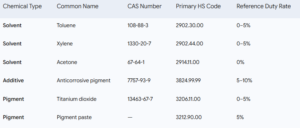
Note: Always cross-reference the HS Nomenclature Explanatory Notes (updated 2025) and the latest official rulings from the General Department of Vietnam Customs to avoid misclassifying “mixtures” as “pure substances” (and vice versa).
Critical Risk Mitigation Guidelines for Coating Chemical Declarations
- SDS Validation: SDS dossiers must be in Vietnamese or English and updated to the latest GHS Rev.9 version.
- Specialized Logistics: Hazardous substances (flammable, corrosive) must be transported in specialized containers or temperature-controlled reefers if necessary.
- Component Reporting: Declare the exact concentration of every ingredient exceeding 0.1% for chemical mixtures.
- Filing Timelines: Declarations must be filed before vessel arrival. Delays incur demurrage/detention costs of VND 500,000 to 2 million per container per day.
- 2026 Inspection Trends: Increased random checks on high-VOC chemicals. As eco-friendly water-based coatings are prioritized, compliant green pigments and additives benefit from accelerated clearance.
- Expert Solutions: SMEs frequently make HS classification errors, leading to tax reassessments or severe penalties. Partnering with a professional agent reduces logistics turnaround and costs by 30–50%.
Vietnam Coatings Market Trends (2025–2026) and Regulatory Impacts
According to industry reports, industrial and protective coatings will lead growth in 2025–2026, spurred by infrastructure megaprojects. “Green” paint segments (low-VOC, powder coatings) are expanding at 10–12% annually.
This trend demands greater agility in chemical declarations, introducing bio-based pigments, eco-friendly solvent alternatives, and heavy-metal-free additives. Importers must closely monitor updated lists from the Ministry of Industry and Trade to adjust chemical formulations proactively.
The Coatings Vietnam 2026 Exhibition presents an ideal venue to source cutting-edge technologies and consult with specialized logistics partners.
Professional Customs Declaration Services for Coating Chemicals at NSLVN
With over a decade of hands-on expertise, NSLVN delivers comprehensive, end-to-end coating chemical declaration services:
- Complimentary HS/CAS code consultation and pre-import document audits.
- Rapid electronic declaration via VNACCS, linking directly with relevant ministries.
- Dedicated logistics for hazardous and sensitive chemicals, backed by compliant storage facilities.
- Transparent, highly competitive pricing with guaranteed on-time customs clearance.
Hundreds of paint manufacturers nationwide trust NSLVN to optimize and safeguard their supply chains.
Do not let compliance bottlenecks stall your cargo at the port. Contact NSLVN today via our website at https://nslvn.com/ for free consultations, detailed quotations, and the most reliable, precise, and efficient chemical declaration support in 2026. Our team of compliance experts is ready to partner with you!